Categories
Meditations

God’s Secret Stairway


(To gain a further understanding of the meditation that follows, a reading of the indicated scriptures will be most helpful)

Genesis 28 : 10 – 22 (1)
Matthew 9: 9 (2)
 

As Jesus went on from there, He saw a man named Matthew sitting at a tax collector’s booth. “Follow Me,” He told him. And Matthew got up and followed Him.

It is most likely that in the retelling of the story of another person’s life, or even one’s own story, that some critical elements fall into the silence.  There are private pictures captured by the soul; that words can never convey; there are feelings that run too deep for tears and remain best left for their expression, to tears alone. Some mysteries of life, found in physical objects, gain an almost sacred status to a person.
William Wordsworth’s pastoral poem “Michael,”
presents just such a truth. The poem tells the story of an aging shepherd, Michael, and his only child, Luke. When Luke reached the age of eighteen, Michael decides to send him away from home. Some years previously, a debt incurred by Michael now threatened the future of their farm. The plan was for Luke to move from home and live with a merchant to prepare him in financial matters, and thereby help assure the future stability of the home situation. Before his departure, Michael had Luke lay the cornerstone for the sheepfold they were planning to build together. Away from home, Luke falls in with unfavourable companions. Consequently, in time it became necessary for him to flee to another country. It is the unfinished sheepfold that silently proclaims the old man’s heartbreak.

“’Tis’ not forgotten yet
The pity which was then in every heart
For the old Man—and ’tis believed by all
That many and many a day he thither went,
And never lifted up a single stone.
There, by the Sheepfold, sometimes was he seen
Sitting alone, or with his faithful Dog,
Then old, beside him, lying at his feet.
The length of full seven years, from time to time,
He at the building of this sheepfold wrought,
And left the work unfinished when he died.” (3)

Every human attempt to produce a complete image of “Michael’s” life, must prepare for a glaring deficit if words are the only permitted vehicle of expression.

Similarly any attempt to write the biography of
Matthew, one of the twelve disciples of Jesus, must have consideration for such phases that go beyond the ability of mere words to express.
Almost for certain the tax- collector’s booth in Capernaum remains a catalyst for touching memories to the end of Matthew’s life. It is here that a life-changing event has its beginning. It is at this tax-collector’s booth that the search for ‘Missing Matthew’ starts. It is here, in another more important way, that Matthew is found.
The Roman authorities are at the scene in an instant. There is an immediate consensus among them that this is the another light-fingered employee. But the mystery of the missing man named Matthew only deepens.
Scrutiny of the ledgers provides an accurate accounting for every penny and every debtor. What now? Ask the public for help? Had anybody noticed any suspicious behavior taking place in, or around that vicinity of late? No revealing evidence is forthcoming. Then, in a casual conversation, someone chances to mention catching sight of ‘The Nazarene’ in town. The government ledgers yield no information about any interaction with any Nazarene.
The most important business transaction of the hour was not to be found in any written ledger anywhere on earth but indelibly written on one man’s heart and in Heaven’s records. That man is Matthew.
Matthew will never forget what he saw, and what he felt inside himself the day he stood facing the young man Jesus, on the other side of the wicket gate. One look into Jesus’ eyes set him free from the cramped quarters of the tax collector’s booth. In those eyes, Matthew saw freedom,
peace, and serenity, like quiet mountain streams, deep and clean. The look on Jesus’ face reflects something about humanity that Matthew has almost forgotten; pity, mercy, and love.

The intensity of the moment dawns upon Matthew when he recalls the experience of his forefather
Jacob. One evening while fleeing in absolute fear from his brother, Esau, Jacob lay down to sleep, with a stone for his pillow. In the darkness, Jacob had a dream, in which he saw a ladder stretching between Heaven and earth. Heaven’s comfort and assurance continues throughout the night. Jacob takes his pillow of stone in the morning and sets it apart from all others, saying,” Surely the Lord was in this place, and I knew it not.” In reverential silence Matthew whispers. “Surely the Lord Is in this place……Who will ever believe it? The Lord’s secret stairway into my life is a tax collector’s booth.”

We never decidedly choose where, or in what way we will become aware of God’s Secret Stairway into our lives. It wouldn’t be a secret if we knew, now would it? But there is a stairway God reserves for Himself, and I pray that you, one day soon, will rejoice to see it!

“We may not climb the heavenly steeps
To bring the Lord Christ down;
In vain we search the lowest deeps,
For Him, no depths can drown.

But warm, sweet, tender, even yet
A present help is He;
And faith has still its Olivet,
And love its Galilee.

The healing of the seamless robe
Is by our beds of pain;
We touch Him in life’s throng and press,
And we are whole again.

O Lord and Master of us all,
Whate’er our name or sign,
We own Thy sway, we hear Thy call,
We test our lives by Thine!” (4)

Prayer To Follow This Meditation

Father, thank You for opening Heaven’s door to me and for coming down Your secret stairway. Sometimes I am too busy, or too afraid, or too preoccupied to even think about You. Your secret stairway permits me now to expect You to come, and perhaps sit at my table any day, or to join in the company of my family or friends at any time.

In the Garden, where His friends entombed the body of Jesus following His Crucifixion, Mary went to mourn and to weep. It was there, at the site of her expected devastating grief, she discovered Your secret stairway into her life.

Father, thank You for leaving Heaven’s Door ajar for me, so that I may always have easy access to You. You have decreed that the traffic on Your secret stairway can go in two directions.
Give us the faith, and the courage to believe.
In Jesus Name we pray. Amen.

Hymn: A Mighty Fortress Is Our God
https://youtu.be/H0Evv-LaUeQ


Editorial Notes
1 & 2. Here and throughout the text that follows all
quotations from THE HOLY BIBLE are from THE
NEW INTERNATIONAL VERSION (NIV)
3. WILLIAM WORDSWORTH. In “MICHAEL.”
English Poetry 11: From Collins to Fitzgerald
The Harvard Classics 1909-14 372 .Michael
4. JOHN GREENLEAF WHITTIER. In “WE MAY NOT CLIMB THE HEAVENLY STEEPS.”https://www.poemhunter.com/poem/we-may-not-climb-the-heavenly-steeps/

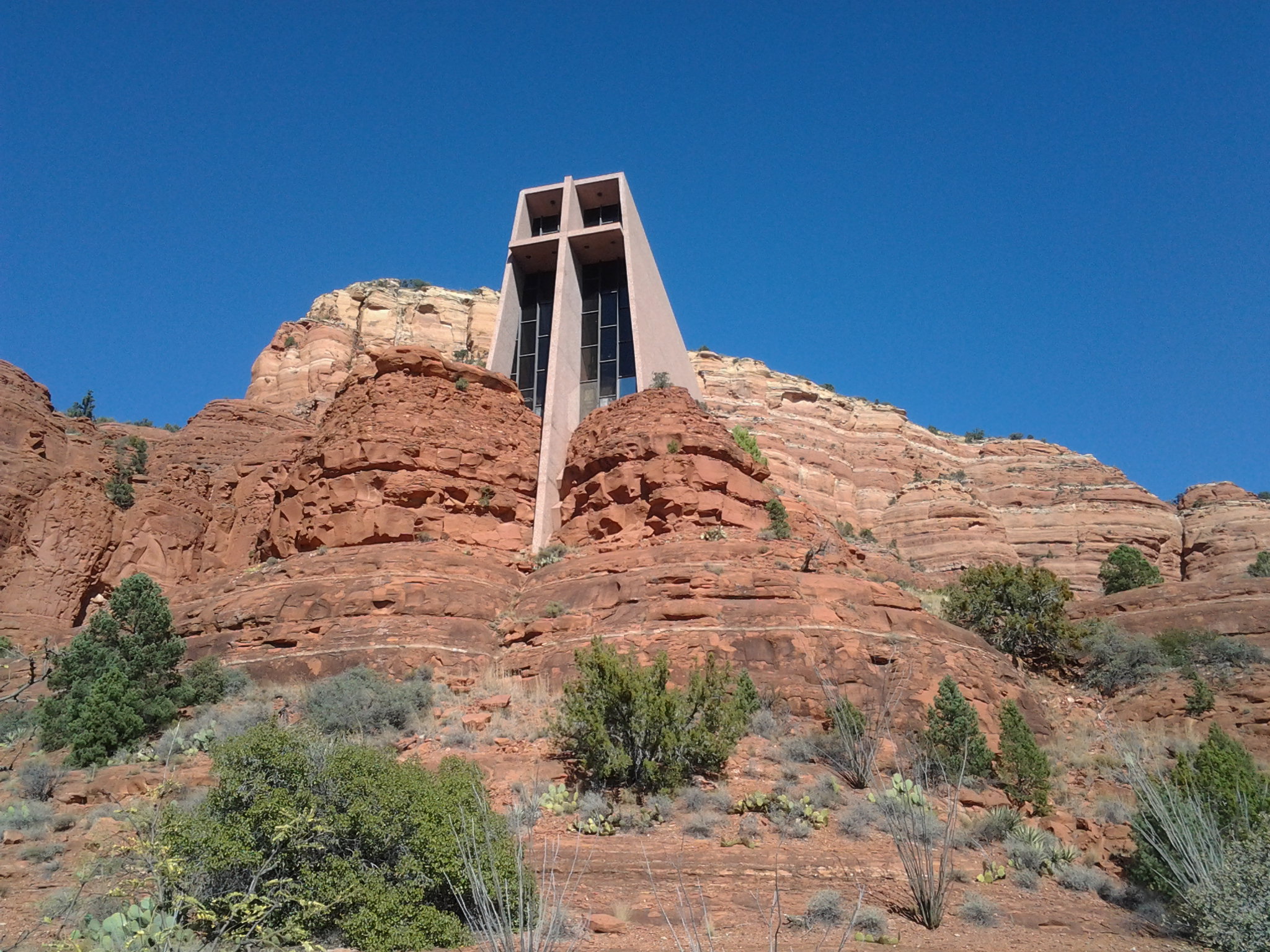
Photo: The Chapel Of The Holy Cross, Sedona, Arizona.  taken  November,2016.


.



Categories
Meditations

The Divinity That Shapes Our Ends

(To gain a further understanding of the meditation that follows, a reading of the indicated scriptures would be most helpful. In addition, the Editorial Notes at the end of this post may provide further understanding)

Joshua 5: 9 – 12
Luke 15: 11 – 32
It is easy enough for humans to get trapped in the labyrinth of life, and then spend the remainder of their days decrying the seeming futility of it all. But suppose there is no such thing as a useless experience for any human on this earth – no lost good, no forgotten hope! What if a sojourn in the labyrinth is, after all, the highway to the kingdom of success and incredible fulfillment!
The Story of Joshua referenced above makes us aware of forces that batter the lives of the ancient Hebrews. Lost in the ‘slave pens’ of the Delta for generations, God’s chosen race is free at last. But that is not the end of the labyrinth. A forty-year trek through a pitiless, scorching desert is just beginning.
Is there a Divinity behind all that? Is there a purpose behind the wailing and the crying? How can any of those experiences be shaping a destiny? Forty years in the scorching desert, enduring the blistering scouring of driving sand – while still trying to keep alive a vision of a new place to call home – seems far beyond the most rudimentary understanding of fairness or decency. From the desert’s red-hot crucible of experience, individuals emerge reshaped into a community.

Let it never be forgotten, that all through these formative years a Divinity is shaping their destiny. Every day, in one corner of the scene or another, the Hand of God is in evidence: wiping the tears of a child, giving a song of victory to some over-laden soul, or laying ‘Bread from Heaven’ at the doorstep of some hungry family. Above all else, Divinity is the one thing needed to make sure that “Hope springs eternal in the human breast.” God is keeping them alive for an end that He alone can see. Apart from those momentary glimpses of God, they are destined to succumb to the tortures of futility. This truth has even further application.

The world’s pre-eminent dramatist, William Shakespeare, creates his famous character Hamlet as one hopelessly lost in the maze of belittling and disgusting behavior. He proceeds through his swiftly moving years –  sometimes pensive, but never committed; often hot-headed, but never serene. Then one day there is a moment of startling profundity. Hamlet utters an immortal truth!
“There’s a divinity that shapes our ends,
Rough-hew them how we will.”
(Act 5, Scene 2)

Hamlet is acknowledging that there are many things out of his control and that in the end, it is God who will determine our destinies. Even though the rough-hewn years of Hamlet’s life are self-appointed, this can never nullify the abiding fact: there is a Divinity that shapes life – Hamlet’s, and ours too.

Again, it is a fact of divinity shaping lives that provides the impetus for the telling of one of the greatest love stories ever told. This story, commonly known as “The Story Of The Prodigal Son”, is told by Jesus, the Master of Life. The younger of two sons in their father’s employ grows restless and responds to a call for adventure and unfettered freedom. He takes every step, in his mind, to ensure that this farewell will be forever. He takes everything he owns, and everything that the future and his father’s love might yet provide, and heads into the twilight.

The gaping entry into the labyrinth is always deceptive. Friends are waiting to introduce him to all kinds of new adventures. Away the young man goes, dancing his merry way. Away from home, away from decency, away from respectability. He is so inebriated with all “the good times,” that he doesn’t notice how narrow and restricting the maze is becoming. Soon there is barely room for one to travel alone, all alone. It is at that precise moment, Jesus tells us : He came to himself, and said, ‘How many of my father’s hired servants have enough bread, and to spare, and here I am dying from hunger. I will arise and go to my Father.’ There is divinity, shaping a life that was self-inflicted with rough-hewn experiences. For what purpose did Divinity shape the young lad’s decision processes? What is the purpose of reshaping his life, or any life? It has everything to do with destiny. That destiny is to finally know the Love of God that transforms every life into a thing of extreme beauty. In the service for the Lord that follows, even the scars from the rough-hewn wounds will speak eloquently of the Divinity that shapes our lives.

“With mercy and with judgment
My web of time He wove,
And aye the tears of sorrow
Were lustered by His Love;
I’ll bless the hand that guided,
I’ll bless the heart that planned,
When throned where glory dwelleth
In Emmanuel’s Land.

O Christ, He is the fountain,
The deep, sweet well of love!
The streams on earth I’ve tasted
More deep I’ll drink above:
There to an ocean fullness
His mercy doth expand,
And glory, glory dwelleth
In Emmanuel’s  land.” Amen.

Prayer To Follow This Meditation

Open my eyes today that I may see You
In all Your Glory,
my ears that I may hear You, offering Love to replace malignant hate,
my mouth that I may speak from the casket of my heart where You have stored the treasures
of Your Love and Your Peace!

You are providing the way out of this labyrinth that is tearing apart this severely wounded world. Give us the courage to arise and come back to You. With humility may we sit at Your Table and receive from Your Hand our daily bread, thereby rejecting the offer to select sustenance from the contaminated menu of this world. In Jesus’ Name we pray. Amen.

Hymn :          Lead Us, Heavenly Father, Lead Us


https://youtu.be/JAve_-XMoMY


Editorial Notes
1. The Holy Bible. Here and throughout this discourse, the quotes from Scripture are from The New International Translation Of Scripture, NIV.
2.William Shakespeare. In The Tragedy Of Hamlet Prince Of Denmark. Act 5, Scene 2
ww.w3.org/People/maxf/XSLideMaker/hamlet.pdf

3.  “Lead Us, Heavenly Father, Lead Us”

4. Photo:     ‘The Sea’  Taken in Brigus, Newfoundland

Categories
Meditations

SOULS LAID BARE

( To gain a complete understanding of the meditation that follows, a reading of the indicated scriptures will be most helpful)

Job 42: 1 – 6
Mark 12: 41 – 44

“Calling his disciples to him, Jesus said, ‘I tell you the truth, this poor widow has put more into the treasury than all the others. They all gave out of their wealth; but she, out of her poverty, put in everything – all she had to live on.’ Mark 12:43

What in the world was she thinking? What has taken her rational faculties hostage? What is it in human nature that makes some willing to sacrifice everything, even life itself?
To satisfy this inquiry, it will require more than anthropological research. Nor will a careful review of political ideology provide an incisive reason for the self-sacrificing action of any kind. However, our present inquiry into the behavior of this particular individual requires a survey from a higher elevation than anything that is of human understanding alone. It is, after all, the Master of Life who acclaims her action in giving away everything, even though this action may be perceived as detrimental to her future well being. Will there come a time, perhaps, as early as her next meal time, when she may well regret her decision?
This choice, according to Jesus, is undertaken to satisfy the urgency of her soul to contribute to the Temple Treasury.
Consider the dynamic in any person, that presents itself as being more important than the preservation of physical life. In that endeavor, it is not forbidden to us to listen at the door of this particular person’s life, to learn the secret of what is within her soul. To accomplish this, we will have to supplement the few facts recorded about her, with the use of our imaginations, upon which we implore the guidance of God’s Spirit.
It will be helpful for our present discussion to create a name for this Jewish lady, so from here on she shall be known to us as Elizabeth. The Hebrew name Elizabeth means “My God Is Bountiful.”  Even a cursory glance at the brief story lends itself to a conclusion that this is an appropriate name for her.

Elizabeth may well be one of those who reflects William Wordsworth’s description of newborns coming into this world, trailing the evidence of Heaven’s glory:

“The Soul that rises with us, our
life’s star,
Hath had elsewhere its setting,
And cometh from afar:
Not in entire forgetfulness,
And not in utter nakedness,
But trailing clouds of Glory do we come
From God, who is our Home.” (2)

However, unlike the newborns described by Wordsworth, who too soon lose the suggestion of Heaven’s likeness, Elizabeth is destined to reflect that quality throughout adulthood. Whether it is a natal characteristic of Elizabeth, or something born out of necessity to deal with life’s hard knocks, Elizabeth owns a unique and special relationship with God. So authentically beautiful is that attitude towards God that Jesus, the Master of Life, identifies it as a liberal investment of Heaven’s riches. It is evident that this lady proves every day that her God is bountiful! She can proudly claim her ancestry with David, the Psalm writer, who understood life in this way: “In the shelter of Your Presence, God, You hide me.” ( Psalm 31: 21).

The loneliness and the devastating pain of loss have left their scars upon her. Ask her whose hands are even now applying the balm required for slow-healing wounds. Scanty meals and insufficient resources are her constant companions. But not a worry for her, mind you, rather they are daily conversation pieces between her and the unseen Guest at every table. Elizabeth could never allow her inner life, for any reason, to sever ties with the personal love of God.

“Neither death nor life, neither angels nor demons, neither the present nor the future, neither height nor depth, will separate her from the love of God.”
( Romans 8: 39).

Be assured that Elizabeth would never, in a thousand years, permit the slightest semblance of the attitude of her critics to come anywhere near her! That soulless rationality was a complete anathema to her! No dawn ever brought a need severe enough, and no twilight could bring unrest disturbing enough, for her to look anywhere but within the fortress of her soul, where her Bountiful God was faithfully on guard.

Do you suppose the soulless rationality of onlookers prompts Jesus’ comparison of the value of Elizabeth’s gift to all the others made that day? An inner life severed from the personal love of God is necessarily impersonal, legalistic, and abstract. A religion that becomes purely rationalistic becomes hostile to life. A soulless rationality will never inspire one soul to discover “the love so amazing so divine, that demands the soul, the life, the all.”

Present circumstances, in many ways, suggest that Western Christianity is falling into the shadows of this world’s eclipse. Now is the time for all those who preserve the glory of Heaven in their lives, to speak unabashedly of the same.
Let them daily live by their soul’s conviction that the greatest response they can make to the world’s brokenness and sorrow is to offer the gift of God through Jesus Christ our Lord. Amen.

Prayer To Follow This Meditation
Father, Job was confident that he knew everything possible to know about You. He listened to the voices of earthly wisdom expounding popular views of eternal things. He listened to soothsayers propound their personal conclusions about the way the human race should be. And Father, Job was confused!
But yet, we still have not learned the one essential lesson, that Job did in the end! It is not what all others have to say about God and eternal things that matter most! It is what one sees when he looks inside himself. This experience may well produce the vision of God heaping blessings upon one from His abundant store. Mere rational thoughts about God fall silent then, as Job’s did, and in their stead we will cry out: “I heard about You with the hearing of my ears, but now I have seen You with my own eyes.” (Job 42: 5)
Amen, So let it be.

Footnotes
1. Scripture references in this text are from the
NEW INTERNATIONAL VERSION, NIV of The
Holy Bible.
2. William Wordsworth. In INTIMATIONS OF
IMMORTALITY. Section v in “IMMORTAL
POEMS OF ENGLISH LANGUAGE”.
Edited by Oscar Williams. First printing
July 1952.

Categories
Meditations

Your Day Of Self Discovery

( To gain fuller understanding of the text that follows a reading of the following Scriptures will be necessary)

Matthew 9:35 – 10: 1- 8
As you go, preach this message:” The Kingdom of
Heaven is near. Heal the sick, raise the dead,
cleanse those who have leprosy, drive out demons.
Freely you have received, freely give.”

Colossians 1:24 – 29 the glorious mystery, which is
                                        Christ in you, the hope of glory.

It is a scene from His immediate environment that dictates to Jesus the need for immediate action.” When He saw the crowds, He had compassion on them, because they were harassed and helpless, like sheep without a shepherd.” (Matt.9:36). The action that follows is the naming and assigning of twelve men to that scene, as His disciples.
Jesus saw people; helpless people, adrift everywhere on a tormenting sea. There were some with gaunt expressions from trying too hard for too long, with no measurable results. He saw people on their way to sit with the dying, but who had little, or nothing to offer by way of the promise of immortality. Jesus saw the broken and the diseased who daily stormed the gates of the eternal city, with one persistent question, “Why?” Jesus saw disease and death stalking through the land like the legendary giant of the Philistines. It was written large on all their faces:” Who will slay our Goliath?” Everything that Jesus saw in that hour demands supra-human strength to address! Indeed, such malignant darkness requires a supernatural intervention.

Is it some angel of heavenly light and glory that is chosen to address this daunting crisis? No! Oh, amazing wonder, it is ordinary, and for the most part, ignorant men that Jesus selects for this mission. (Acts 4:13)
Who, from among the ranks of everyday people can ever imagine such a mission to be their destiny? The Old Testament Records document the reluctance of such men as Moses and Jonah, to ever consider such divine appointments. The Divine utterance,”Certainly, I will be with you,” provides some consolation; nonetheless, it leaves them still with lingering reservations.

We will never begin to understand the divine commission of Jesus, and the disciples ” going out” to face such unspeakable challenges until we are aware of the driving motive behind it all.
In the final analysis, the propulsive thrust behind this mission is the ‘ compassion’ of Jesus: “When He saw the crowds, He had compassion on them.” True, the disciples see the same scene as did Jesus. They see the misfortune of their fellow countrymen and women.They see their pain, their misery, and the sorrow afflicting them, and they do feel pity for them.
However, there is considerable difference between ‘ pity ‘ and
‘ compassion .’ Pity belongs more to the reality of our shared humanity. Each is a part of the human family, inhabitants together of this earth. ‘ Compassion’ belongs more to a consideration of our spiritual inheritance, and our cohabitation with God in our spirits. “In God, we live, and move, and have our being.” (Acts 17:28). What Jesus sees is more than cases of leprosy, mental illnesses. sorrow and loss. He sees God before He sees anyone or anything else. God holds each broken piece of humanity in His arms until they regain their true identity as Children of The Kingdom. This image is the epitomizing action of the Kingdom of God in the midst of the people.And that is the message Jesus instructs his disciples to deliver, thereby substantiating the actions they undertake. ” As you go,” He instructs the disciples, ” Preach this message: ‘The Kingdom of Heaven is near.’ In the Presence of God, in God’s Kingdom, all brokenness affecting the human condition is removed. ( Rev. 21:4) ” He will wipe every tear from their eyes. There will be no more death or mourning or crying or pain , for the old order of things has passed away.”

Images of this world’s brokenness, sorrow, disease, and cruelty in Jesus’ experience ,are juxtaposed with pictures of a perfect resolution.
Alongside the image of some lonely grave where a loved one sleeps, Jesus sees a home of many mansions and the beloved walking beside the Crystal Sea.
But, Alas! For many today this is just a beautiful picture hanging on the wall of a history museum.The message of Pentecost removes the framework, permitting the inclusion of everyday people to receive the Spirit of Christ, as the earlier disciples did, in their preparation for service.The whole of the New Testament is a spiritual event, to recreate the world by the transforming presence of Jesus in human lives. St Paul summarizes the message in this way: ” God has chosen to make known among the Gentiles the glorious riches of this mystery, which is Christ in you, the hope of glory.” ( Colossians 1:27)

From the inestimable wealth of their Master’s spiritual treasures, Jesus’ followers are well-prepared to fulfill the formidable tasks He entrusts to them. And in the meantime demonstrate to the world, through their actions that the Kingdom of God is here. May this be the day, and this the hour when greater numbers of people will discover once more, the vision which God holds of this world.That vision will be fulfilled only by a willingness to appropriate the resources of heaven through Jesus Christ. Amen. So let it be!

“Our blest Redeemer, ere He breathed
His tender last farewell,
A Guide, a Comforter, bequeathed
With us to dwell.

He came in tongues of living flame
To teach, convince, subdue,
All powerful as the wind He came
As viewless too.

He came sweet influence to impart,
A gracious, willing Guest,
While He can find one humble heart
Wherein to rest.

And His that gentle voice we hear,
Soft as the breath of even,
That checks each fault, that calms each fear,
And speaks of Heav’n.

And every virtue we possess,
And every victory won,
And every thought of holiness,
Are His alone.

Spirit of purity and grace,
Our weakness, pitying, see:
O make our hearts Thy dwelling place
And worthier Thee.”


Prayer To Follow This Meditation

Father, of unspeakable mercy,
We praise You that You have not given up on Your Vision of making this world Your Kingdom like Heaven is. Even though the world in this hour is so twisted out of shape by suspicion and pettiness, Your love will not let us go. “Behold, I make all things new, and the old will pass away.” You keep telling us. Save us from giving up on ourselves, when You hold such strong determination to use ordinary people like us to be catalysts for the new day dawning. In Jesus Name we pray. Amen.

Footnotes

(1)Biblical references throughout this text are from the New International Translation of Scripture. NIV.+
(2) Harriet Auber, 1829 ” OUR BLEST REDEEMER, ERE HE
BREATHED” in Hymnary, The United
Church Of Canada.#162.


Categories
Meditations

Candlelight In The Darkness

( To gain a further understanding of the meditation that follows, a reading of the suggested scriptures will be most helpful)

Scripture Reading: Joshua 24: 14 – 18 (1)
Matthew 5: 14 – 16 (2)

Joshua 24: 16 – Then the people answered, “Far be it from us to forsake the Lord to serve other gods!  It was the Lord our God himself who brought us and our fathers up out of Egypt, from that land of slavery, and performed those great signs before our eyes.”

When truth triumphs over falsehood, it shines as a beacon of hope in the surrounding darkness. To be a harbinger of such light is to inspire the hope that the Prayer Jesus taught us to pray – “Thy Kingdom Come” – may yet find fulfilment in this world.
The saga of the Hebrews’ journey into the Promised Land presents them with just such a challenge.

Moses is dead!  That, in and of itself, is an unfathomable loss.  Gone from them is the powerful presence of God’s spokesman.  The Hebrews leave a lonely grave somewhere in Moab, and under the leadership of Joshua, they journey towards the new homeland.  Even from a distance, they become aware of the different world view awaiting them in their future home. The atmosphere is seething with new customs and philosophies – to say nothing of the practices of foreign religions. Where will they find a suitable anchorage for the Truth that liberates?  Searching questions come from the lingering shades of new prosperity so close at hand.  Is it Providence or mere chance that leads them from slavery to riches?  Is the cry of Moses – “Let  My People Go” – meant to be the command towards this new temptation for moral and religious freedom? What is Truth?  Perhaps manna from Heaven appears in many new forms now, and it is everywhere.  Many of them wonder whether it is more appropriate to ‘thank God’ or to ‘thank their lucky stars.  The Darkness was dense and threatening.  No one could deny that fact, but what to do now is the immediate consideration.

They must consider three alternatives.

1.   They can submit to the darkness, as many of them will, or curse the darkness and the day that brought them to it.

2.  They can condemn these foreigners and their misguided religions.

3.  They can light a candle and let its effulgent rays shine on in the darkness.
“It is better to light one candle than to curse the darkness.”

But where is the ‘candle’ with intensity enough to penetrate this insipid darkness?  Some in the company of travellers find it too easy to yield to the darkness, and soon they intensify the struggle for their fellows.  Some, however, experience the stirring of new life force in the deepest places of their souls and strike back at the darkness.  “Far be it from us to forsake the Lord and serve other gods!  It was the Lord our God himself who brought us and our fathers from the land of slavery, and performed great signs before our eyes.” And there it is, a faint glimmer of light in the intense blackness. Even if the masses choose the darkness of the night, even one lighted candle cannot be forgotten. The ingredients to drug the mind into forgetfulness are so abundantly accessible to each one in their company.  Is there anything that can intercept that onslaught?  What if, in their earlier experience with manna from heaven, a mother holding her starving child in her arms finds life-saving Manna outside the door of her tent?  Would she not be likely to respond to her cohorts, “As for me and my house, we will serve the Lord. We know that it is the Lord who works awesome deeds for us.”  Would that memory not stimulate others to recall personal happenings that make no sense at all, apart from the fact of the Lord’s doing?  If that can happen, causing one after the other to light their candle, soon it will not be the darkness that is most prominent but ‘the lights of a city set on a hill.’ (Matt, 5:14)

It is the most urgent need in this modern day of unimaginable darkness to bear witness to the light that is within our souls and proclaim its source unabashedly.  Then the dark demonic forces of our age will have met their match.  We need not interrogate our personal experience too extensively to discover some incident of the Lord’s mighty deeds in our lives.

Even at the risk of being too personal, I feel compelled to relay the following experience. But, then, personal experience is all I have that is essentially my own.

At the age of eighteen, I was wrestling with my future career choice. Would I be an engineer, or a teacher, or somehow learn to deal with a persistent nagging in my spirit to be a minister?  I tried being a teacher for a year, and while it was a satisfying experience, I decided not to continue in that profession.  Perhaps I needed some indication that I should strike ministry from the list as well.  At the age of eighteen, I became a lay pastoral minister to three far-flung congregations.  I was all alone and scared, yet all the time, a haunting realization persisted that I was not alone.  While all of this happening to me was exciting and fulfilling, I kept assuring myself that, in the end, engineering might be “the greatest of the three”.

And then, one close, muggy evening in mid-spring, I had a deeper encounter with the darkness.  I was scheduled to be the guest preacher at an ecumenical service.  There was a large congregation present, which contributed to the stifling atmosphere inside the church.  I stepped into the pulpit to deliver the sermon.  At the same moment, a choir member somewhere behind me, deciding that a measure of cool, refreshing air might now be desirable, proceeded to throw wide a window.  In came the breeze, and away went my copious supply of sermon notes, and on came the darkness!  It was serious, particularly for a boy of eighteen years.

I stood there in the choking silence for a moment, and then, I tell you, I was aware of another Presence in that pulpit with me that night!  And in the silence, I heard,

“My Son, don’t be afraid, we will do this together.  Do you think that everything depends on you and your notes.”
“No Lord, I guess it doesn’t, it is all up to You.”

I have completed nearly fifty years in ordained ministry, and the One who stood with me in that pulpit has never left my side. The light still shines, and no darkness has ever been able to put it out!
__________ ___________

Prayer Based On This Meditation

Thank You, Lord, for standing in for me when
my knees were too weak to hold my weight; and the
darkness came quickly on, and I imagined all
kinds of horrible dangers lurking in the dark.

Life is often like this. It is so easy for it to manufacture situations where anxiety breeds in a minute. One minute there is peace, the next minute there is chaos. Then we are left to pick up the shards of faith caused by the shattering blow of guilt. It is then that you come to us as the ‘Light,’ which enables us to find every missing piece. That completes the picture of You working upon a mere mortal to make it ‘something beautiful for God!’  Thank You for taking the smallest act performed in faith and preserving it as something magnificent and valuable towards my completion in ‘this vale of soul making.’
In truth, I will never be able ‘to stand in’ for You.  I am ready, though, to stand with You and to speak as You will give me utterance.  Here I am, use me; I am willing to be Your candle in the darkness!  I offer this prayer for Your love’s sake. Amen

Hymn:                           Ave Maria


Editorial Notes
(1) (2) Here and elsewhere throughout this text Scripture
References are from The New International
Translation Of Scripture. NIV.
(3) Thought to be an ancient Chinese proverb, often quoted.

Photo: Taken at our summer place  in Michael’s Harbour, Newfoundland, 2017


Categories
Meditations

What Does God Require?


WHAT DOES GOD REQUIRE

Suggested Scripture Reading Micah 6: 6-8

Scripture Emphasis:
John 6:28 – Then they asked Jesus, “What must we do to
do the works God requires?” (1)

Viktor E. Frankl, the founder of the Viennese school of Psychiatry known as ‘Logotherapy,’ suggests that it is not at all’ belief’ in God that is most important. It is, instead, the portrayal of God in a person’s behaviour that makes God irresistible. Therefore, Frankl concludes: “If religion is to survive, it must be profoundly personal.” (2)

It is an exciting journey from mere belief to an authentic portrayal of God that is irresistible. It is something of this journey that I wish to share with you now. All I ask of you is the use of your imagination. Let it be the door through which the Spirit of God will lead you to a more authentic experience.

I am Ezra Ben Sirach.

In the New Testament lesson of today, I am one in the crowd. Most of those in Capernaum today experience the charismatic effect of Jesus’ presence. However, we believe in Jehovah God, which is our proud Jewish inheritance. However, there is no denying; there is something beautifully challenging about how this man Jesus, speaks of God. It is so different, considering that Jesus is himself a fellow Jew. It is as if God is right there beside Him. I believe God seems far away and distant in the best of times. I think I would do anything if my faith could impact others like he is impacting me!

I confess I am the one who steps out of the crowd and asks Jesus: “What must we do to do the works that God requires?” I felt compelled to do something. What follows is one of the most incredible happenings of my entire life. Today I move from being a respectable believer to becoming fully alive for the Glory of God. But I am getting ahead of myself in my story. All of this experience is so exciting that I can barely contain myself.

I remember, as a child receiving instruction on obeying the Law. I understood that to mean doing something to please God or not doing anything to displease Him. The Ten Commandments are the primary focus of everything I know about God. I always make a concerted effort to do good work. But then I wonder if what I do is ever sufficient. I fear that doubts began long ago to get the best of me. In the company of other worshippers, I keep saying that I do believe, but  Oh! I do so earnestly want to feel that God sometimes smiles at me

Today I meet the man Jesus! And God is right here. Jesus’ life is entirely effortless. He never produces a checklist to ensure that he strictly complies with some written Law consisting of things He had to do or not do to have a good relationship with God. Today it seems to me that He reaches into the crowd, lifts my heart, and holds it ever so tenderly in His hands. That is the moment when I find the courage to ask Him,” What must we do to do the work that God requires?” What follows is best understood as a glorious light that comes flooding my mind. I experience such tender compassion from Him. He addresses me as though I am the only one present with Him there. He doesn’t single me out in the crowd; He permits me to remain anonymous. Is it the tender compassion of Jesus that prevents John from identifying me in his Gospel? I doubt not that that day Jesus’ witness had many pondering what might be required of them to be like Him. I am glad to be a spokesman for the many!

“My brother ( He calls me His brother! I am so honoured),  it is not a matter of doing that is required, but rather it is all a question of ‘being.’ Be my faithful follower, then you will learn what to do. Live as habitually and as simply as possible on that level of your being where I dwell. For it is there ‘where Spirit with spirit meet, you will find God is closer than breathing, nearer than hands and feet! ‘”. (3)

“I’ve found a Friend, oh, such a Friend!
He loved me ere I knew Him;
He drew me with the cords of love,
And thus He bound me to Him.
And round my heart still closely twine
Those ties which nought can sever,
For I am His, and He is mine,
Forever and forever.” (4)

A Prayer To Follow This Meditation

Saviour, speak the word only but not for the benefit of our physical ears. Instead, fine-tuning the sensitivity of our Spirit’s hearing will command lasting allegiance to You.
As long as our spirits are disengaged, the Good News is lost in the world’s too-familiar hum. “Where the Spirit rests unknown, fatal is
 the letter “.
Awake us to the beginning of a new day in Your Presence,
O, Christ. Then shall we come to know God even as He knows us, and He will show us the gifts bestowed upon us to complete our tasks, like You did, for the Glory of our Father. Amen

Ascription Of Glory
“Now to Him who is able to keep you from falling and to present without blemish before the presence of His glory with rejoicing, to the only God, our Saviour through Jesus Christ our Lord, be glory, majesty, dominion, and power now and forever.” Amen. Jude 24.

1. The Scripture quotes are from The NIV Translation
2. Viktor E. Frankl . In “The Unconscious God.” p.15f
3. Alfred Tennyson. In “Higher Pantheism
4. James G Small. in “I’ve Found A Friend, O Such A  Friend.”


Categories
Meditations

Making Angels

Psalm 8:4. What is humankind that You are mindful of them? You made them a little lower than the heavenly beings and crowned him with glory and honor.
Matthew 28:19.  Go and make disciples of all nations .

The Hebrew narrative of creation is at the same time both poetic and extremely challenging. With broad strokes, the created order emerges from a formless void. Then and only then does God create humans in His image. People, through the use of their unique and particular endowments, are now co-workers with God to fill in the details of the broad framework of God’s creation. Therein, the challenge of the narrative begins to focus more clearly.

Through the life force given by God to people, all creation will, with one voice, bring glory to God.  God bestows upon the human race alone the unique capacity to draw the riches of the created order unto themselves – not to selfishly possess them as their own but to hold them in their spirit. When these riches return to the world, they bear the enhancement of the human spirit.

Of all creation, the human being alone possesses a spirit, which is the dwelling place of the eternal Creator.

All material things emerge from the incredibly fertile soil of this world, and through connection to an individual’s spirit are refreshed and animated anew. This process enables the entire earth to participate in the Sanctus.

The Old Testament is rich in the expression of how things less than human acquire human attributes to contribute to their Maker’s praise:

The trees of the forest will clap their hands. (Isa. 55: 12)
The young lions seek their meat from God. (Ps 104:21)
the morning stars sang together. (Job 28:7).

It is as though those who temporarily adopt those earthly things impart something of their spirit to them. In this way, humans who are bearing the Image of God continue His work towards completing creation.

If such is the truth of things less than human, what about those individuals who for some reason have forgotten or who disregard Imago Dei, the image of God?  Is it not a supreme challenge above all others, to engage in the creation of angels by seeking to help restore contact with God (who yet dwells within them) those who may absent themselves from Him?

God does not remove from any living person the ability to respond to spring’s return. Let the words of St. Irenaeus be the impetus for service: “The Glory of God is a man ( or woman) fully alive.”

It was a bitterly frosty winter evening several years ago when the police spotted a young man most unsuitably dressed for the raging storm.  He was seeking what little shelter he could find in a local storefront, but there was no hiding the fact that his chances of surviving the night were minimal.

He was too cold to engage in any explanation for his plight, other than that his father had severely beaten him and had forced him from home, which was several miles from his present location.  It quickly became evident to the police that the lad needed medical attention, and they immediately transferred him to the local hospital, where he remained under care for several weeks.

It was during this time that I became involved in the situation, invited by the staff to offer assistance to a frightened, hurting, lonely young man, who consistently resisted every approach suggested.  It took many long and painful weeks for this young man to relive the horrid experiences that resulted in our being together.

His fifteen years were devoid of any verbal expressions of love that he could recall, or even the slightest recognition of the fact that he mattered.  His clothes were hand-me-downs, and he could not recall ever having footwear that was especially his very own.  Many times a detailed plan of escape was in his mind, but he was aware of how much his little income meant for his younger siblings. That concern kept him a hard working employee of the local fish plant and the victim of gross abuse.

Over the weeks, one of the most heart-wrenching tales of human abuse I ever heard emerged.  In measured, painful syllables often punctuated with bitter sobs, it all came forth.  But even more than that, it became evident that deep inside, in spite of everything, there was a kind and compassionate person who would bring much beauty into this world if only afforded the dignity of being a somebody, and a valued child of God.

One afternoon towards the end of his lengthy stay in the hospital, I suggested we spend some time at a local mall, just as a change of setting.  At first, he reluctantly declined, and soon I came to understand his reason. There beside his bed there lay a pair of ragged and completely worn out sneakers – his only footwear.  Not a word was spoken as he bent down and slowly ties the tattered sneakers to his feet.  A pleasant afternoon ensued, and I heard the music of laughter from my friend for the first time.

We were about to leave a store when we noticed a large display of winter boots directly in our path.  My friend slowed and stopped for a moment to look.  His longing gaze touched my heart. “Would you like to have a pair of those?”, I quietly asked. “Yeah, but I can’t.”, he concluded and abruptly turned to leave.

I tell you what, man, you pick them out, and try them on, and let’s see if we can knock the ‘t’ off that “can’t”!

Considerable persuasion was necessary, but the look on that face as we headed to the check-out is one of the most rewarding things I can remember; that memory coupled with a call I received from my friend’s nurse later on that same evening.

“I thought of calling you last night to invite you to come down to see something.” she quietly began. “I went into Lewis’s room rather late at night and was so surprised to find him lying on his bed still wearing his new boots. ‘Lewis,’ I protested, ‘it’s time you were asleep. Now remove your boots and get into your bed.’ ‘No, miss,’ he responded, ‘these are boots my buddy bought for me and I ain’t goin’ to part with em.’ If indeed, God’s whole plan of creation  employs the human spirit to enliven the inanimate or even lifeless objects to celebrate the divine, how more  far reaching is the effect  of holding a lost and broken  human being in your spirit until they too are reawakened to experience God and offer their celebratory praise to Him.

My part in this whole story is minuscule. This world is in need of ‘Angel Makers’ , and I assure  you that there is no shortage of ‘raw materials ‘ available.

My prayer remains to this hour that Lewis has found the One who prepares the  feet  with readiness for the  Gospel of Peace through Jesus Christ.(Ephesians.6:15) And I do believe he has.

Categories
Meditations

Bruised Reeds And Smoldering Wicks

Scripture Reading: Isaiah 42; John 21

Isaiah 42: 1 – 4: A bruised reed He will not break,
and a smoldering wick He will not snuff out.

The Old Testament writings are deeply inspiring in their authors’ ability to portray the gentleness of God as the world awaits the advent of the Messiah. God is a shepherd who has patient disregard for the slowness of the sheep; portrays the human condition; and indicates the endless love the coming Messiah will require. Then the long-awaited revelation of Divine love arrives as an innocent and helpless Child.  Isaiah teaches his followers to sing: “Unto us, a child is born, unto us, a Son is given, and His name shall be called Wonderful, Counsellor, the mighty God, the everlasting Father, the Prince of peace.”

No Scripture captures more succinctly and thoroughly the awesome beauty of the New Testament God, which Jesus conveys, than the image in the Old Testament of the bruised reed and the smoldering wick.

The reed once stood tall. It danced in the gales and shone in the sun. Its beauty changed with each passing season. It nestled safely against the earth’s breast when winter bore down upon it with fury. It sang and swayed gently to the music of spring’s return. The reed preached eloquently to all passing by, of the Providential care of a gentle unseen hand.

The wick, on the other hand, was a human-made object. It is true that in the beginning, the wick is the inspiration of the Creator of celestial and everlasting light. Now it fulfills its function in the home, in the town, in the streets, and in the world. It gives light to all. It brings comfort on a stormy night when the visibility is diminishing. It is a gift that can never receive value in common currency when the shadows of the evening lengthen, and the darkness in the valley is made less dark because of the glowing wick.

But nothing remains unchanged in this world. Time passes swiftly by and sweeps everything along with it. All too soon, both the reed and the wick are mere shadows of their former being and find a place on the heap of discarded things.

But wait! Turn the page! ‘The bruised reed and the smoldering wick’ is not a parable about expendable things. It is rather a parable about God’s way of dealing with people.
The bruised reed tells the story of individuals who were once standing straight and tall, but now the vivaciousness of youth has fled, and time lays its burden upon them. Or it may be a more nefarious burden in youth that weighs the heart and stoops the shoulders.
Now the actual meaning of the parable of the bruised reed appears: “The bruised reed He will not break.” The Gospel immortalizes the tenderness of God through Jesus Christ, who embraces those with drooping heads, and heavy hearts, and strengthens them by His Cross. “The bruised reed He will not break.”

“The smoldering wick He will not snuff out.” Once more, the Gospel captures the tenderness of God in Jesus Christ, as He rekindles a new flame of devotion in tired and weary spirits. Peter, the disciple of Jesus, was contemplating a return to his fishing boat because for him everything had changed with the death of Jesus. But by the sea of Galilee, and in response to Jesus’ question, “Peter do you love me?” Peter becomes ‘The Rock’ upon which the church is built. The smoldering wick He will not snuff out.

When our day is over, and we can no longer engage in sharing His Light with others, be assured that the wick is not extinguished. In the shelter of His Presence, it will glow with perpetual light, and from heaven, one more light will be added to lessen the world’s darkness.

Reoice, the Lord is King;
Your Lord and King adore;
Mortals, give thanks and sing
And triumph evermore:
Lift up your heart, lift up
your voice;
Rejoice; again I say Rejoice!
____________________

1. Here and throughout this text, the Scripture quotations are from The New International Version. NIV.
2. Charles Wesley. In “Rejoice The Lord Is King.” Stanza 1,
#112. ” The Hymnary” The United Church Of Canada.”
========================


Categories
Meditations

TARNISHED ANGELS


To gain a further understanding of the meditation that follows, a reading of the suggested scriptures will be most helpful. Also, a study of the Editorial Notes at the end of the post may prove to be beneficial)


Scripture Readings: Luke 19: 1 – 10
Revelation 21: 1 – 5

Luke 19: 9 Jesus said to Zacchaeus, “Today salvation has come to this house, because this man, too, is a son of Abraham. For the Son of Man came to seek and to save what was lost.” (1)

Thirty years before this recorded event two significant happenings occur.

One, in Bethlehem, is recorded like this: “The angel of the Lord appeared and said to Mary, ‘Don’t be afraid, Mary. God has been gracious to you. You will bear a son, and you will call him Jesus. He will save his people from their sins.’ (2) “When the right time came, God sent His Son, born of a woman, born under the law.”(3)

The other happening occurs in Jericho: Another boy is born. His parents while looking upon him for the first time see what is to them, no doubt, the face of an angel. Soon after his birth, his parents begin searching for an appropriate name that would capture the essence of this beautiful gift from God. They decide upon a name rooted in their Hebrew heritage – a derivative of the Hebrew words for clean, pure, righteous.  “Zacchaeus,” they whisper over and over to each other. “His name will be Zacchaeus. We shall call our boy Zacchaeus”

Now, some thirty years afterward, the two of them meet face to face for the first time: Jesus, the Saviour of the world, and Zacchaeus ,a tarnished angel!

But what happened to Zacchaeus? What tarnished the angelic beauty that inspired his name? William Wordsworth, a poet of a later century, in his “Intimations Of Immortality” offers convincing evidence on the question:

We come from God, who is our home, trailing clouds of
glory; Heaven lies about us in our infancy!
Shades of the prison-house begin to close
Upon the growing boy. The Youth, who daily from the east
must travel. At length, the man perceives it die away and
fades into the light of common day (4)

But is there no antidote for such a fateful malady? Is ‘tarnishing’ the indefensible fate that awaits all that are born into this world? According to Wordsworth, the shades of the prison-house close upon the growing boy, and he continues to lose his natal glow, until at last it fades into the light of common day.

This world is never kind to high ideals and noble principles. It still crucifies the compassionate and berates its lovers. It disregards every desire for the restitution of former glories.

There remains, however, for each person, one window in the world’s prison-house that permits the light to cast its effulgent rays into the darkest prison.  From the moment it is experienced, that light transforms defeat into victory. It is the abiding Truth that enlightens the whole world. The experience of William Wordsworth quoted above is not the end of his story. There is much more awaiting him beyond the walls of the prison-house:

And I have felt A presence that
disturbs me with the joy
Of elevated thoughts. (5)

The angelic appearance once glimpsed by the parents returns now for all the world to see.  An angel’s presence, once realized, needs never to be irreparably lost.  Let it be forever written indelibly on each person’s heart:  “A man’s reach must exceed his grasp” (6)

Everything that Zacchaeus achieves in his lifetime, including his employment as a Roman tax collector, does not end his constant searching.  Everything he grasps leaves him still reaching. Could it be something that was his at birth is eluding him and making him reach? Is it that same natal gift observed by his parents that so endeared him to them?

One day Zacchaeus’ reaching finds its reward!  It is Robert Browning in his poem “Andrea del Sarto” who advises:  “A man’s reach should exceed his grasp, Or what’s a heaven for?” (7).

The truth begins to dawn upon Zacchaeus. Everything he calls his own all too quickly disappears. Nothing of this world is eternal. Materiality always changes and eventually it decays. There is but one thing worth reaching for, and which abides forever. It Is the gift of spiritual worth that heaven offers.

Zacchaeus, the tarnished angel, meets Jesus, the One who specializes in restoring ‘tarnished’ humanity. Jesus says to him, “Today salvation has come to this house, because this man, too, is a son of Abraham.  For the Son of Man came to seek and to save what was lost.” (8).

Zacchaeus is a tarnished angel no longer. By the grace of God, he is enabled now to bring a little more of heaven into his troubled world. So may it be for us! Amen

Hymn:                  Amazing Grace – Andrea Bocelli

Editorial Notes

1. Luke 19:9.
Revelation 21: 1 – 5
Here and throughout the text Quotations from
The HolyBible are from the New International Version.
NIV.
2. Luke 2: 26 FF.
3. Galatians 4: 4
4. William Wordsworth. in “Intimations Of Immortality.”
5. William Wordsworth. in “Tintern Abbey.”
6. Robert Browning. in “Andrea del Sarto.”
7. Robert Browning in “Andrea del Sarto.”
8. See #1.

9.Photo: Taken at our summer cottage, at Michael’s                                     Harbor, Newfoundland, 2017 


Categories
Meditations

Seeing The Invisible


                    Seeing The Invisible 

Scripture Reading: Matthew 9: 20 – 29
Hebrews 11: 1 – 10

Matthew 9: 20-21  A woman who had been subject to bleeding for twelve years came up behind Him and touched the edge of His cloak. She said, “If I only touch His cloak, I will be healed.” Jesus turned and saw her. “Take heart, daughter,” He said, “your faith has healed you.” (1)

Few authors of English literature, if any, can surpass John Milton’s epic skills.  Observe his portrayal of the agony and the horror of blind Sampson in “Sampson Agonistes.”:

O loss of sight, of thee I most complain,
Blind among enemies,
O worse than chains, dungeon,
or beggary or decrepit age.

Light, the prime work of God to me is extinct! (2)

We are told, however, of blindness that far exceeds the crisis of physical blindness.  It is this trait: “though seeing; they do not see; though hearing, they do not hear or understand.” (3)

The old man’s features bore the evidence of having been born on a rugged, windswept coast where he survived and laboured for more than three score years and ten.  His face resembled the crevices in the cliffs along the Northeast coast of Newfoundland, from whose wild shores he fished for more than half a century.

I saw him for the first time as he sat beside his hospital bed.
The need for medical attention resulted in a journey far from home. He was physically separated from his familiar surroundings, but he was still back home in his mind and spirit. He was doing battle with the winds and the waves off the headlands he knew and loved.

Mentally, he had slipped his moorings and was unable to distinguish reality.  Now it was the treacherous rocks and the shoals of memory that he was navigating!  The crank at the foot of his hospital bed was for him now the flywheel of his fishing boat’s engine; and as he had done millions of times before in real life, he heaved with all his might, hoping to start the motor!

You know how one’s heart pains to see the helplessness of a brother or sister in the vicious throes of mental confusion.  I have come to believe that the kindest thing one person can do for another in such a circumstance is to still the urge to show them the reality, and meet them where they are at the moment!

A look of utter dread and unbridled fear crept over his face. “See those clouds in the west,” he urged, “I tell you, there is a fierce gale in them; and here we are, helpless and adrift!” He barely took the time to finish his sentences before resuming his strenuous effort!

“Old skipper,” I proposed, “just move over, and let me give it a try.” He did. Sheepishly, I grasped the crank in my hands and made the same throwing motion I had observed him make. Momentarily, I said to him, “Listen, old skipper. Do you not hear that? The engine is running. We are on the move! See those lights twinkling from the shore; they are the lights of home. Head for them, and we will be safe from the storm.”

A look of ineffable peace replaced the look of fear. It was as though we had found a passage through the treacherous tangles of memories, and headed out into the open sea of renewed hope.

When at last I near the shore, 
And the fearful breakers roar
‘Twixt me and the peaceful rest, –
Then, while leaning on Thy breast,
May I hear Thee say to me,
“Fear not, I will pilot thee.” (4)

We’re all heading home, you know! It’s a good practice now and then, to check and make sure that we can see the lights of Home.  It is not with the physical eyes shall we see, but with the eyes of the soul; lights from ‘the city that hath foundations, whose builder, and maker is God!’ (5)

But where does the certainty of that city lie?  Of what value is faith, when all things are under threat of an avalanche of mental confusion and unrelenting pain?  What happens when the mind and the soul become helpless prisoners of the body?
A New Testament incident full of mental, physical, and emotional pain provides the help we need. It is a picture of an unfortunate woman who is an absolute prisoner of herself!

This woman had suffered for twelve years without a break. In addition to the physical agony of her condition, the financial and social consequences of her malady had brought inestimable loss. In her efforts to find a cure, prudence in spending had gone with the wind.  Friendships ended in a haze of suspicion and lingering uncertainties.  now under a cloak of less painful anonymity, she braved the likelihood of even more public scorn.
Is there anyone who cannot understand how such a grievous circumstance could quickly become the walls of a prison to shut one away from every other living soul?  All this woman could see night and day for twelve years was the gathering storm clouds with their foreboding threat.  She was like one who dwelled in a house of mirrors.  Everywhere she looked she saw the images of her disintegrating self.

Only the gift of God’s Holy Spirit can penetrate such utter human darkness. Only God can put a window in the solid brick of any person’s prison wall. Only God can remove the fog from spiritual eyes, and enable one to see the lights of home.

I can not tell you the precise moment that the Spirit of God came to her.  It was the time of her deepest heartache, sorrow, and longing; perhaps at a time when tears dimmed her vision, as she recalled familiar faces of some she once called friends.  In spite of everything she had endured, she finally convinced herself:  “If I can only touch His cloak I will be healed.” (6) That was God’s moment! That was the moment of supreme hope! Was there a more valuable treasure she would one day find in the present world than the treasure she now appropriated through the eyes of faith?

Can hope itself ever disappear forever?  Does hope spring eternal in the human breast?  Will there come a time when there will remain only prison walls with no liberating window?
No, a thousand times over no!
Although the evidence of the physical world is overwhelming, the human spirit having once been embraced by God is sure of God forever!

I have heard of a group of tourists who journeyed to the North East mainland of Kenya to view the breathtaking splendour of Kilimanjaro. The highest peak of Kilimanjaro, Kibo, reaches a height of 19,340 feet.  Imagine how disappointed the tourists were to arrive and to find the majestic peak enshrouded in clouds.
One of the tourists wrote in her diary: “We were about to return to our hotel not having seen the very reason for our trip.  As far as were concerned, perhaps Kubo never even existed.  Suddenly, just for a few seconds, the clouds parted, and there it stood in original magnificent splendor. The moment was breathtaking.  Too soon the cloud cover returned, and Kobo has hidden from our view again.  It made little difference now. We had seen Kobo, and we were sure of Kobo’s majesty and extreme beauty forever.” (7)

Here is the truth concerning us.  Once we see with the eyes of faith the twinkling lights of our Eternal Home, we will be convinced forever.  If the mists of this life befog our mental capacities, our spirits will guide us to the safety of the Harbour.  Nothing can ever change that.

I am confident of this as well:  that the woman who sought one day to touch the hem of Jesus’ cloak and remain undetected by Him returned to repeat that action again and again, for without the trappings of physicality she saw the invisible, and there is nothing more significant than that.
Be near when I am dying,
O show Thy Cross to me;
And for my succor flying,
Come, Lord, to set me free:
These eyes, new faith receiving,
From Thee shall not remove,
For he who dies believing
Dies safely through Thy love. (8)

Hymn:  Jesus Saviour, Pilot Me

https://youtu.be/VXJwWCUYr8c


1. Holy Bible NIV. See Matthew 9: 20- 22 p.1498 -1499
2. JOHN MILTON. In Sampson Agonistes, Lines 65 – 75 p.553. In Milton’s Complete Poems and Major Prose. Merritt Y. Hughes, edit. Published by Hackett Publishing Company Inc.
3. Holy Bible NIV. See Matthew 13:13 p.1504.
4. Edward Hooper. In JESUS, SAVIOUR PILOT ME. # 444 in The Hymnary. United Church Of Canada. P351
5. Holy Bible NIV. See Hebrews 11: 10 p.1853
6. Holy Bible NIV. Dee Matthew 9: 21 P. 1499
7 . Unidentified to me
8. Tr. from the German of Paul Gerhardt by James Waddell
Alexander. O SACRED HEAD, NOW WOUNDED stanza 4.
# 94.Hymnary. United Church Of Canada.p79-80.
In Hymnary. United Church Of Canada
9Hyhttps://www.youtube.com/watch?v=VXJwWCUYr8c&feature=youtu.bemn: Jesus Saviour Pilot Me.